Showing posts with label Peel. Show all posts

Friday, 9 May 2014

TPT and Bridgewater Way as Commuter Routes - Conclusion

Current Cycle Provision for Commuters

In three previous posts I've reviewed my current route to work.  Having suffered a hit and run on a quiet road in Sale I've looked for alternative, away from road routes as like much of the country there are no safe road based routes.  The Trans Pennine Trail (TPT) and Bridgewater Way are the major cycle provisions within Trafford and the latter is currently being promoted as the big facility for cyclists.  Trafford have said that they can't provide facilities on sections of the A56 and are promoting the Bridgewater Way as the recommended alternative.  So it will therefore form the recommended commuter route through the borough and into Manchester.

Whilst the Bridgewater Way runs roughly South to North the TPT runs West to East and is part of the National Cycle Network.  It is a route that runs from west to east coast and should be a major part of the network within Trafford.  It's also been established for around fifteen years so provides an example of how Trafford looks after its cycling facilities.

Trans Pennine Trail Positives

  • The trail through Trafford whilst touching on residential areas is almost entirely within countryside making it a pleasant environment to ride through.
  • Very little if any interaction with motorised vehicles.

Trans Pennine Trail Negatives

  • Most of the surface is unmade or rough stone.  The former is totally unsuitable given the prevailing weather conditions and the mixed mode usage and the latter makes for a rough ride with the potential to cause an accident if a wheel glances the wrong way off a stone.
  • Rotted vegetation combined with the unmade surface and horse excrement makes a slippery and unsafe surface.
  • In many places the encroachment of vegetation has reduced the trail to as little as 2 - 3 feet width - insufficient for two people to pass.
  • The lack of lighting makes it unsuitable as a commuter route for most people for much of the year.
  • The unmade surface and multitude of puddles means commuting in office clothes is just not possible if you want to look presentable.
  • The unmade surface coats bikes in a layer of grit which makes short work of bike gears and wheels.
  • Anti-motor cycle barriers are largely redundant but still dangerous and restrictive to cycles.
  • Shared usage means that you can be brought into conflict with horses and dog walkers.  Usage seems to be low during 'rush hour' so this is not a major issue currently.

Bridgewater Way Positives

  • The canal provides a pleasant green corridor through the borough
  • No interaction with motorised vehicles
  • Solid surface (I'll ignore the unmade bits as they are in the process of being upgraded)

Bridgewater Way Negatives

  • Rough surface - the surface may be solid but no part of it is smooth and large stretches are down right lumpy.  This makes for a rough and uncomfortable ride even with large volume tyres,
  • Pea gravel - this is an unnecessary hazard.  It can make pedalling difficult and steering unpredictable.  It is very unnerving to have to pass other path users by going onto the loose gravel alongside a drop into water.  If you need to stop quickly there is a good chance the bike will skid and you'll lose control of it.  If you come off the bike that gravel will make a right mess of your clothes and skin.  It will also become embedded within any cuts and cause pain in its removal.
  • Width - the path even at its widest is only just wide enough for two cyclists to pass.
  • In some places the encroachment of trees has already reduced the width of the path so that only one person at a time can get past.
  • The lack of lighting makes it unsuitable as a commuter route for most people for much of the year.
  • The Sale and Stretford sections of the path are heavily used during the spring and summer months by walkers, runners, dogs and rowers.  Trying to push a load of commuters down the same narrow path just leads to conflict and a stop start journey.
  • The Patricroft section in Salford is used by a number of anglers who can spread across the whole width of the path.  Most are cooperative but some just block the path.
  • The width of the route in Salford is far sub standard.

Conclusions

Whilst the TPT and Bridgewater Way are welcome additions to the few cycling facilities that there are in the area, they are far from adequate when viewed as a commuter.  They might just about be ok for a leisurely pootle or a one off journey but they are not conducive to regular use.  The poor build quality of the TPT and the lack of maintenance of it mean that it is now not much better than a bridleway and is unsuited to using even a touring bike on it.  This latter is quite comical really when considering that it is a route for getting from one side of the country to the other, i.e. touring.

The principle gripe for both facilities is the path surface, cyclists need a smooth, firm surface that is not going to break up.  The fact that the Bridgewater Way is actually a newly laid tarmac surface but isn't remotely smooth shows a piss poor attitude to specification or quality control, or no understanding of what a surface is like to ride along.  The pea gravel surface also shows a complete lack of understanding of cycling requirements.

With very little promotion the Bridgewater Way is already a well used route by commuters trying to avoid the horror of the A56.  It is also a well used leisure facility for local residents and has been for many, many years.  Combine the two and there are unpleasant issues for all users.  Promoting it as the cycling alternative to the A56 clearly shows that Trafford just can't see cycling as a means of transport other than by a few die hards or they are unwilling to put any proper money into it, preferring instead to plough more and more money into the overcrowded road and tram systems.

Both routes are effectively remote and equivalent to a back alley at night.  The lack of lighting therefore means that they can not thought of as an alternative safe route for most potential cyclists - would you recommend your wife or daughter use them on a dark winter's night?

With poor standards of driving, poor attitude to cyclists and lack of traffic enforcement cyclists need segregated cycling facilities of a far higher standard than the two routes here.  Without them there will not be the significant increase in cycling that the government and council are supposedly working towards.

Wednesday, 16 April 2014

Trafford's Cycle Networks - Part 2 - The Bridgewater Way

For much of its length in Trafford the Bridgewater Canal roughly parallels the extremely busy A56.  Kate Green is the MP for Stretford and Urmston and has challenged the council on the lack cycling provision along the A56 as well as other places.  Issues and response can be found here. The council explain the lack of facilities as follows :
Historically it has been very challenging to provide  dedicated cycle facilities on the A56 due to the restrictions of available road space, and the obvious need to keep traffic flowing on this congested route.
There could be a large heated debate on this statement but I won't go into it here. They provide an alternative which in theory could be reasonable
For this reason, we have adopted a policy in recent years of promoting high quality alternative parallel cycle routes to the A56.  Most particularly, the Council has secured £1.3m from the government’s Local Sustainable Transport Fund to extend the current extent of the ‘Bridgewater Way’ canal tow path walking and cycling route, matched by private sector contributions and the Council’s own funding
So the council see the provision of the Bridgewater Way as a high quality alternative to the A56. You'd therefore expect it be absolutely first class in order to attract drivers to commute by cycle and reduce the congestion on the A56.  However, this is cycle provision in the UK and particularly Trafford, so it falls some way short of good.
Whilst the canal towpath has been improved from Brooklands northwards I join it from the Trans Pennine Trail at Watch House Cruising Club in Stretford.  This is the view northwards from just after the cruising club.  The path appears to be of a reasonable width with a good surface.  However, it hasn't been laid well and this section always has large puddles if there is any sign of rain.  The surface is also rubbish.  It's been covered in pea gravel.  Apparently this is for safety reasons when it is icy.  However, for the majority of the year it's a downright hazard.  No cyclist wants to ride on gravel, it makes pedalling more difficult, if it's been newly laid or you're off the walking line it can force where the wheel is going and if you need to manoeuvre or brake hard then you're not on a solid surface.  If you're unfortunate enough to come off it rips through clothing and skin getting embedded in the bloody mess it creates.  On top of this the gravel used early on appears to have been a sharp flint like substance which can make its way through the toughest of tyres.  More recent gravel seems to be more tyre friendly from that point.  A plain tarmac surface would have been much much better as used on cycle paths elsewhere. It would also make the tow path much more accessible for wheelchair users.


Whilst conduit for lighting appears to have been installed (it's absent from later improvements) there is no lighting along the canal and in places there is also none nearby, i.e. it is dark at night.  You'd therefore expect in this risk averse legalistic country that the owners would have wanted any possible dangers removed.  So it's something of a surprise to find that the hole above is sat there just waiting for somebody avoiding a walker or dog to ride into it and go for an early bath.  If I come down the canal at night I'm always glad when I spot this as it means I won't be going for a drink.

One issue that drastically increases with the lighter evenings and better weather is other path users, particularly those with dogs.  This is not to say that they shouldn't be on this particular path but to identify that the shared usage makes it an inadequate cycle provision other than for a leisurely pootle.  In the above photo you can see how much space one lady and her dog take up and how far over the cyclist has had to go in order to pass.  This lady was actually quite considerate and would bring the dog in when someone passed.  However, not all dog walkers are the same and a lot of the time you have to slow down to walking pace, weave around the walker and then dive across to the other side of the path to pass Rover.  

Walkers and runners on their own can be just as big an issue if not more as they frequently have headphones on and are walking down the middle of the path or weaving from side to side.  The headphones make it nearly impossible to get their attention so passing them is risky at any speed and this is invariably on the loose stones put there for our safety.  Then there are the ignorant pairs / groups who quite clearly see you coming but think you can cycle on water.

As an alternative commuter route into Manchester and Trafford Park it falls a long way short of adequate.  It's a pleasant ride but it's not a mass use alternative to the A56.  

The unsuitable pea gravel surface has already been discussed.  However, the tarmac surface underneath is also substantially below par.  No part of the upgraded Bridgewater Way sports what could be described as a smooth surface that would make cycling pleasant.  The section north from Stretford to the A56 is particularly bad and uncomfortable.  The rain water helps show up the ridges and troughs each of which rams the saddle into your delicate parts and shakes your handle bars.  Not even mountain bike tyres can make this comfortable.  I wouldn't want to be in a wheelchair or small wheeled motor scooter along here.  There's no excuse for this surface other than shoddy workmanship and poor quality control. Other cycle tracks can provide lovely smooth tarmac that is a pleasure to ride on, so why do we get this crap?

The locals, they've no road sense and can sometimes be aggressive.


At Stretford Marina there are two sharp bends, one is a very tight ninety degrees and the other is a blind bend.  Both have to be taken slowly but even so are scary with the loose gravel giving the feeling that the tyres might just let go at any moment.

At Watersmeet the Bridgewater divides in two, the right hand branch here going past Salford Quays and on into the centre of Manchester.  The left hand branch under the bridge goes to the canal's original source - the coal mines in Worsley, Salford.  You'd have thought that if Trafford were serious about the canal path being the cycling equivalent of the A56 then the branch towards Manchester would be the first to be upgraded.  No, the next section to be upgraded was an isolated part from the bank of the Ship Canal at the Swing bridge to Park Way.  This either gives more evidence to the theory that Trafford don't see the cycle as a serious means of transport capable of reducing its congestion issues or that Peel, owners of the Bridgewater Canal and with a vested interest in the Trafford Centre, adjacent to the first isolated section, have had influence over which sections are upgraded first.

Whilst another section of the tow path has just been completed from Park Way to behind the Kelloggs factory there is still a short section of just under 1/4 mile that is best described as a mud bath.  Having had no response from Trafford's cycling officer as to why the section had been left I eventually got a quick response from Peel via the Friends of the Bridgewater Canal.  In it they stated that this section hadn't been done as it needs extensive canal wall refurbishment before the upgrade can be undertaken and that the upgrade is expected to be completed before the end of 2014.  My response would be to ask why this wasn't done first as unless you are prepared to negotiate this muddy bit the new section is unusable by bike.  More joined up thinking.


There is evidence that the upgrade will happen sooner rather than later as despite it being the end of March /  beginning of April and therefore the breeding season for our wildlife the powers that be have seen fit to cut down trees and remove all of the undergrowth along this bit.  Work is now under way on the repairs to the canal wall.  The shrubbery and trees have also been removed on at least the beginning of the Manchester branch.
Part way through clearing the bank.

With its large, uneven steps the bridge behind Kelloggs was previously a challenge even to a mountain bike. The upgrade is a massive improvement but yet again a smooth tarmac surface without those stone courses would be much more accessible.


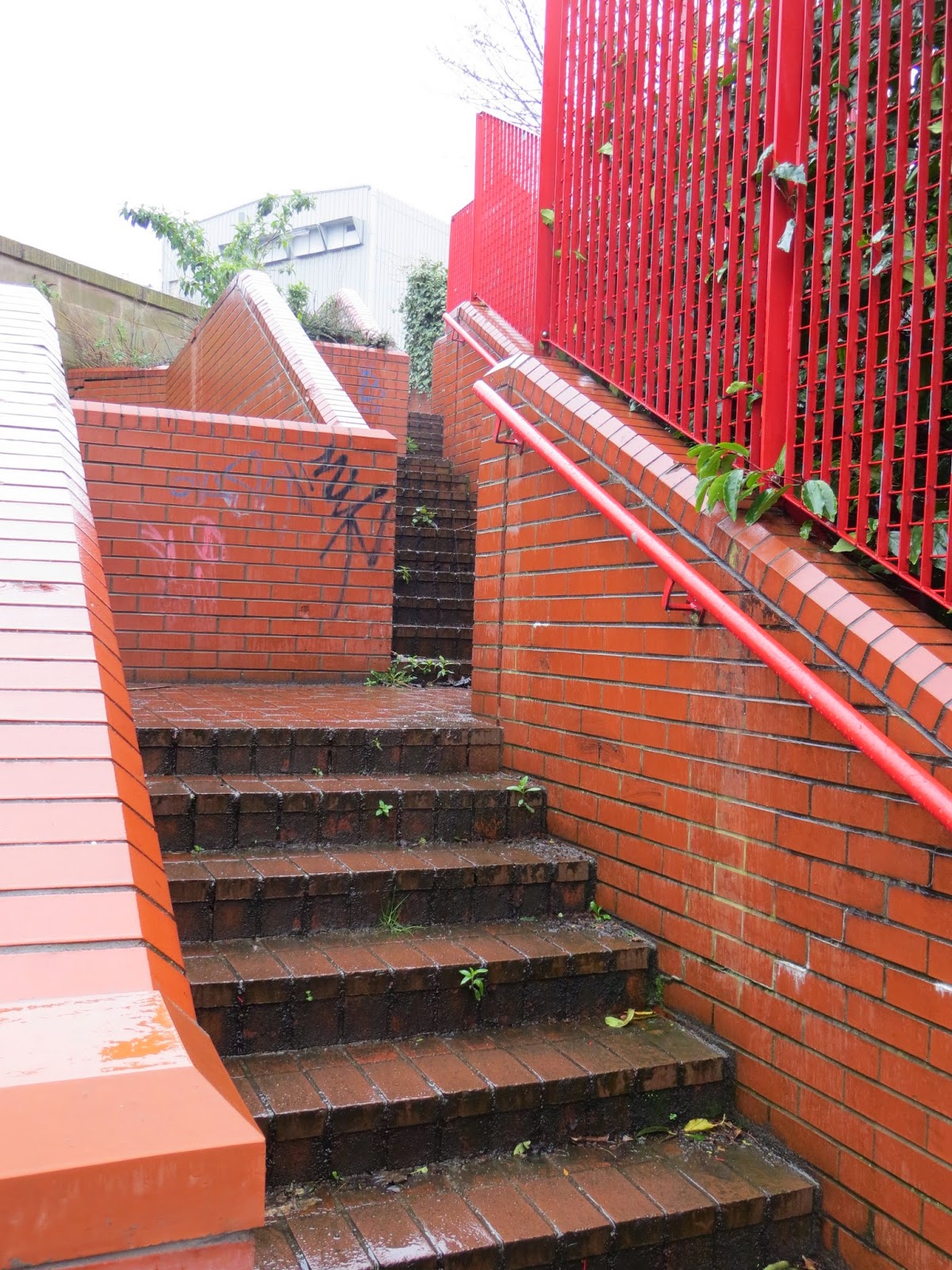
This set of stairs and barrier up to Mosley Rd/Park Rd is the only other access to the southern end of the new section.  Not very welcoming to any cyclist.  A bike won't fit through that barrier.

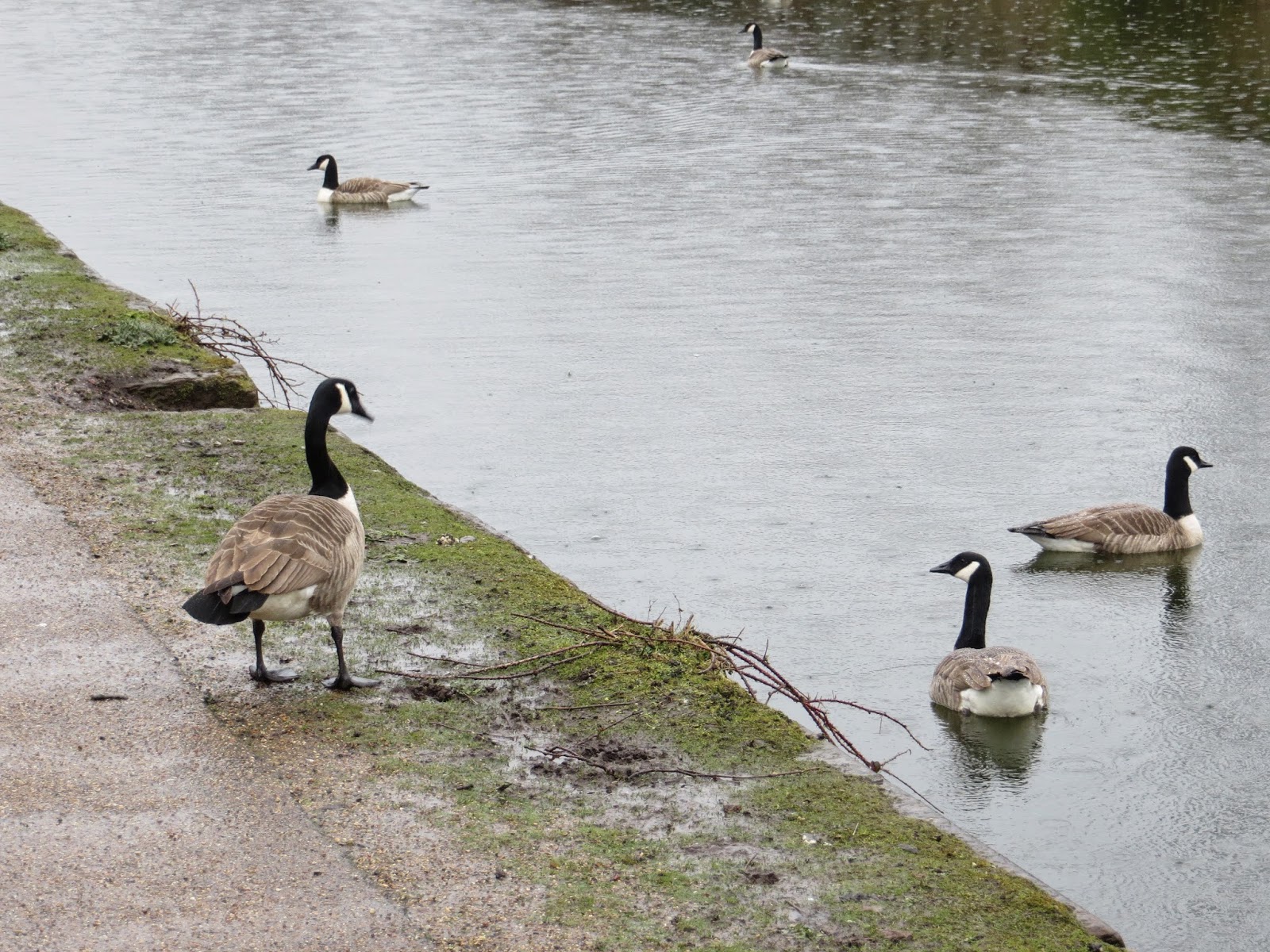
Plenty of the natives (yes I know Canada Geese are not indigenous)

Near the Ship Canal there is this section of cobbles over a bridge.  It needs to be kept for historical reasons but unless you're on large, soft tyres it's painful and wearing on a regular basis.

The Bridgewater Way exits to Redclyffe Road (goes across the bridge) via the existing Chapel Place.  The above is the best view you get of the traffic coming over Barton swing bridge.
 SOMEBODY WILL DIE HERE.
This is the view of traffic coming over the bridge when you get to the junction.  In a word, lethal!  I've raised this with Trafford's cycle officer months ago and he was going to have a site visit, but I've heard nothing since.  At the same time I pointed out that further up the road there was an existing, unused entrance that would provide much better visibility in both directions.  The entrance is just by the pedestrian in the photo below.
Note the useless cycle symbols painted on green squares on the road - these provide no protection whatsoever to a cyclist and do nothing to stop motorists pushing past. 

 Who owns the small bit of wasteland between the canal and the road, I'm not sure but in the two shots  above taken from the towpath a path can be seen though it is not negotiable by bike.  In the last shot it even looks as though at some point there was an official route through.
Crossing the bridge via the footpath is not even an option.  Not only because it is illegal but also because it is so narrow.  There is just enough space for one pedestrian to walk along.