Showing posts with label Trafford. Show all posts

Friday, 23 May 2014

A Let Down

Hit and Run, December 2013

I apologise for length of this post and how long it has taken to produce but it has been a difficult one to write. In previous posts I've written about a hit and run I was involved in back in December. The insurance payout has now been sorted and as the police aren't doing anything with this there's no legal reason not to make the video public.


Hawthorn Lane is a quiet residential road with a small amount of traffic using it to cut through / avoid the narrow Buck Lane. It's the sort of road that should be safe for cyclists and pedestrians. I grew up on Witley Drive and with friends on Hawthorn Lane and Pine Grove we'd frequently ride our bikes in the area.  Please note that whilst we were aged ten or less these were ridden on the road, not the pavement, it was pretty safe to do so then.

I Can't See You

I still fail to comprehend how the incident happened.  The driver claimed that he was only aware that I was there after his wing mirror was clipped.  Considering that I had three decent lights active at the front of the bike, was wearing a bright jacket and the light conditions were reasonable either he was not paying any attention to where he was going with a tonne and half of metal or he has lied and fully intended to bully me out of the way.  Frame by frame analysis of the video shows the driver suddenly steering away immediately before the point of impact, so he was aware of my presence before impact.

His lights are on main beam as he pulls out of Pine Grove so I don't read that as being aggression but simply a case of not having taken the care to check his warning lights as he's started the car.

Damage

The main point of impact with the bike was at the top of the rear gear mechanism where it is bolted onto the frame.  This resulted in the frame being twisted round and the mech pushed into the rear wheel.  The rear triangle has also been bent over to the left hand side.  Somehow the wheel has also been pulled forward out of the frame on both sides.  The twisting of the frame by the rear mech has opened and split the drop out on the drive side thus despite it being possible to rejig a steel frame the dropouts would also need replacing and the frame is therefore well beyond economic repair.

Rear mech pushed round and into wheel.
General view of impact zone
Wheel pulled out on non-drive side
Wheel pulled out, drop out and gear hangar twisted
Splayed and twisted drop out with crack.
Shattered Mudguard
There were additional impact points that caused damage to the rear wheel, mudguard, rear lights and saddlebag. The bike was checked over by a local bike shop, The Bicycle Doctor, and declared to be a write off because as well as the frame damage the integrity of any remaining parts could not be guaranteed following the collision.

Friends and Family

Much of this post is negative, not just because of the subject but due to people/organisation's responses. However, two sets of people have shone.  Firstly family, my wife particularly for not banning me from cycling after yet another interface with a motorist. My mother's contacts and underground spy network was very useful in providing vital information as detailed below.

Friends, particularly those within Seamons Cycling Club have been supportive, not only in analysis of the incident but also in providing suggestions on how to deal with the police.

Police Response

As usual the initial response was good and positive, but things rapidly deteriated. Patrols apparently looked for the car but were unable to find it.  Didn't look very hard did you as the car was back at its registered location an hour later when I made another attempt to go to work. Thus the chance to breathalyse the driver was missed.

The police corresponded with the driver who accepted being involved in a collision and all of the relevant documents were in order. Note that the driver was not interviewed under caution despite illegally fleeing the scene of a collision. It took two further letters explicitly asking whether this had taken place to get an answer.

GMP then closed the case as 'The Crown Prosection Service (CPS) do not call for a prosecution in every case where the incident is of a type that frequently occurs at parking places or in traffic queues, involving minimal carelessness, including cases where there is evidentially a realistic prospect of conviction'

I find this appalling and can only think that GMP are trying to close this case with minimum effort, more on this later. I don't consider that the driver showed minimal carelessness, he was either not paying any attention when the road was full of hazards or he was deliberately driving at me. More importantly he failed to stop at the scene of an incident. This is a clear and serious breach of the law, yet GMP completely ignore it.

Not at all satisfied with this flippant response I sent a letter asking for a better explanation and a series of questions trying to establish how well the incident had been investigated. The response took longer than I expected so I phoned to check that my letter had been received. The officer who was dealing with the case volunteered that 'as a cyclist I should have given way'. I didn't believe what I'd heard and got him to repeat it, which he did. Whether or not giving way was an issue the comment 'as a cyclist' shows a clear indication that GMP are operating a hierarchy - the car is king and I should have bowed to its superiority.

The response did arrive a couple of days later. There are two key paragraphs regarding the collision itself -

'In effect, both you and the other driver appear to be approaching head on and both would appear to have room to move into the nearside to allow passage for both to pass. Neither yourself nor the driver of the vehicle has given way until the last second when you obviously move to the left'

'As it stands at this moment in time the matter would be described as 50/50 in that both parties were attempting to pass through the gap at the same time and that no one gave way to the other'

I'm not sure if this is a cut and paste, 'the other driver' - err, there was only one driver. Ignoring that, I'd possibly agree with their conclusion if I'd been in a car, but I'd have then been blocking the road so he wouldn't have been able to pass. However, the collision took place entirely on my side of the road. There is no need for me to go over to the other side of the road to pass the parked car as is evident by my passing of the first parked car on the left hand side. Going off the trajectory of the car, where would have been safe for me to pull over to, especially considering that he moves further to the right than he needs to pass the parked car? The run up to the point of collision has a parked car on the left, junction on the right, junction on the left and a parked car on the right. There is nowhere safe for me to pull over to and the driver only comes into view as I'm about to pass the first parked car.

Different people may view the causes of the collision differently but the fail to stop is clear cut and probably the more serious offence. The driver has admitted to knowing about the collision but has still driven off. The police report that he claims to have driven around the block and returned about five minutes later. From the video I supplied to the police it is clear that this is incorrect as the video runs for ten minutes after the collision and there is no sign of the driver after he flees the scene. Much of this time I was on the phone to 999 so there would be audio evidence as well. The police admit that he probably didn't return and only responded when he received the notice from the police.

So he has failed to stop at the scene of a collision, admitted that he knew about it and hasn't reported it to the police within the 24 hours allowed. That's a clear disregard for the law, yet GMP do nothing about it. They claim that the video does not prove that he did not return at all. So how long are you supposed to hang around expecting that somebody who's just smashed into you and driven off is going to return?

I pursued the matter further but other than getting a categoric answer regarding interviewing under caution did not really get anywhere. The explanation of the investigation is eye opening though as it is quite clear that the investigation section of GMP is under resourced and so obviously there is going to be corner cutting and carpet lifting.  Five years ago there were 22 officers dealing with investigations, now there are three with six civilians and the same workload.

Clearly as I wasn't injured GMP did not see the incident worthy of proper investigation. Sorry, I completely disagree the fail to stop is very serious and shows complete contempt for the law and other road users, trying to say that the video is not enough evidence to prove he didn't return is an excuse. He didn't stop and didn't report it to the police, that is the offence.

"The incident is of a relatively minor nature, you have the registration number of the third party and as such can instigate your own civil proceedings. This would be the proportionate approach with regards to this matter."

Sorry, but whilst I need to recover my costs, the lack of police action has shown this driver that it is perfectly acceptable to drive into people and ignore the law. This driver needs to be hauled over the coals for his attitude to other road users yet hasn't even had a good talking to by a copper.

As for trying to recover costs the registration number is all very well and good but you still need the driver's details including his insurance and GMP refused to divulge these saying I had to purchase the collision report. This despite it being a legal requirement for the driver to exchange the information.

One other paragraph from the letter is worthy of note, "Can I also state that if we prosecuted every member of the public who failed to stop at a collision within GMP the courts would be full."  That's either a complete nonsensical exaggeration or a very worrying indictment of the attitude of drivers in the Greater Manchester area.

Recompense

Cycle Touring Club (CTC)

Eighteen months prior to this incident I'd been deliberately run off the road, then crashed into before being assaulted.  On that occasion I'd used the CTC's legal service to get a decent level of compensation.  Despite only having minor cuts and bruises the money was more than I'd expected and I was very happy with the helpful service from CTC's solicitors. This time was a completely different story.  I was just about uninjured, (minor bruising to buttock which showed up the following day). When I phoned the CTC legal service I was informed that as I wasn't injured I'd have to go through the Small Claims Court and they'd send out an information pack.  I was shocked, the people I'd expected to support me were providing nothing more than what I could find for myself on the internet.  I phoned again a couple of days later hoping that I'd just caught somebody on a bad day, but no, same story.  When I pointed out that as it was a hit and run I didn't know who to claim against they just apologised and that was the end of that.

With hindsight the Small Claims Court is not the right way to go, or it certainly wasn't in this case.  For a very small fee it is possible to find out the insurance details for the car at the time of the incident and you can then take it up with the insurers.

The Driver

Despite the incident being a hit and run I quickly established where the car lived and through family contacts who the likely drivers were. Lesson - don't defecate on your own doorstep.  Conversations with the police later provided the small bit of information - 'he' - that was required to establish exactly who was driving.

As part of the Small Claims Court process you first have to try and sort things out with the other party by mutual agreement. A letter was duly sent in December laying out my claim, requesting compensation and a response before the end of January.  This was delivered by hand, unfortunately the headcam wasn't turned on so there was no proof.

The given date subsequently passed with nothing being heard from the driver or his insurance company. A second letter was written giving a deadline of the end of March. This was sent on signed for delivery so its arrival was documented.

February and March past with no correspondence from the driver. It can only be concluded that the driver is  a nasty piece of work and the scum of the earth with no morals at all.

The Insurance Company

Despite the CTC and Police both being completely unhelpful in providing or telling me how to obtain the  driver and insurance details I managed to find them out from just the registration plate. I thought I was going to have to fork out around £80 for the Collision Report from the police but after several searches of the internet I came across the Motor Insurance Database which provides the insurance details for the princely sum of £4.

Armed with this information I contacted the insurance company and gave them the details of the incident. Unsurprisingly the driver had failed to inform them of it. They contacted the driver and he confirmed that he had been involved. To my surprise there was no arguing over who was to blame and despite knowing of its existence they didn't ask to see the video either. Things then moved on to proving the damage to the bike and its worth.  This should have been easy as I had the original invoice for the bike, the bike shop's estimate for cost of replacement, receipts for money spent on maintaining the bike and photos of the damage. Despite supplying all of these I failed to convince them that the bike was worth more than the factory specified bike (other than the frame it is a completely different animal).  

This was the one part where I really felt out of my depth.  However, the figure they offered me which I took to be for the value of the bike plus an allowance for out of pocket expenses etc. was slightly less than the value of the bike. When I argued that the value of the bike was more, they said that the original offer was only for the value of the bike not for any out of pocket expenses. 

Having failed to engage the CTC's legal team earlier in the process I was at one time expecting only to recover a couple of hundred pounds having gone to a lot of effort and stress through court wranglings. So, whilst I lost the will to argue onwards about the settlement and was disappointed that I am out of pocket for expenses and some of the cost of the bike, I have achieved a much higher payout then I thought was going to be possible for a long time.

Conclusions

  • Some people are spineless scum.
  • GMP don't understand or care about cyclists.
  • Traffic policing is under resourced and therefore poor. The result is that the roads are becoming more and more dangerous for vulnerable users, i.e. anybody not surrounded by a safety cage.
  • CTC legal services don't cover you as well as you might think.
  • If you're in an incident, make sure you're injured, nobody is interested otherwise.
  • At least one insurance company isn't the angry monster I was expecting them to be.
  • Quiet residential roads that are promoted as being safe for pedestrians/cyclists aren't.

Friday, 9 May 2014

TPT and Bridgewater Way as Commuter Routes - Conclusion

Current Cycle Provision for Commuters

In three previous posts I've reviewed my current route to work.  Having suffered a hit and run on a quiet road in Sale I've looked for alternative, away from road routes as like much of the country there are no safe road based routes.  The Trans Pennine Trail (TPT) and Bridgewater Way are the major cycle provisions within Trafford and the latter is currently being promoted as the big facility for cyclists.  Trafford have said that they can't provide facilities on sections of the A56 and are promoting the Bridgewater Way as the recommended alternative.  So it will therefore form the recommended commuter route through the borough and into Manchester.

Whilst the Bridgewater Way runs roughly South to North the TPT runs West to East and is part of the National Cycle Network.  It is a route that runs from west to east coast and should be a major part of the network within Trafford.  It's also been established for around fifteen years so provides an example of how Trafford looks after its cycling facilities.

Trans Pennine Trail Positives

  • The trail through Trafford whilst touching on residential areas is almost entirely within countryside making it a pleasant environment to ride through.
  • Very little if any interaction with motorised vehicles.

Trans Pennine Trail Negatives

  • Most of the surface is unmade or rough stone.  The former is totally unsuitable given the prevailing weather conditions and the mixed mode usage and the latter makes for a rough ride with the potential to cause an accident if a wheel glances the wrong way off a stone.
  • Rotted vegetation combined with the unmade surface and horse excrement makes a slippery and unsafe surface.
  • In many places the encroachment of vegetation has reduced the trail to as little as 2 - 3 feet width - insufficient for two people to pass.
  • The lack of lighting makes it unsuitable as a commuter route for most people for much of the year.
  • The unmade surface and multitude of puddles means commuting in office clothes is just not possible if you want to look presentable.
  • The unmade surface coats bikes in a layer of grit which makes short work of bike gears and wheels.
  • Anti-motor cycle barriers are largely redundant but still dangerous and restrictive to cycles.
  • Shared usage means that you can be brought into conflict with horses and dog walkers.  Usage seems to be low during 'rush hour' so this is not a major issue currently.

Bridgewater Way Positives

  • The canal provides a pleasant green corridor through the borough
  • No interaction with motorised vehicles
  • Solid surface (I'll ignore the unmade bits as they are in the process of being upgraded)

Bridgewater Way Negatives

  • Rough surface - the surface may be solid but no part of it is smooth and large stretches are down right lumpy.  This makes for a rough and uncomfortable ride even with large volume tyres,
  • Pea gravel - this is an unnecessary hazard.  It can make pedalling difficult and steering unpredictable.  It is very unnerving to have to pass other path users by going onto the loose gravel alongside a drop into water.  If you need to stop quickly there is a good chance the bike will skid and you'll lose control of it.  If you come off the bike that gravel will make a right mess of your clothes and skin.  It will also become embedded within any cuts and cause pain in its removal.
  • Width - the path even at its widest is only just wide enough for two cyclists to pass.
  • In some places the encroachment of trees has already reduced the width of the path so that only one person at a time can get past.
  • The lack of lighting makes it unsuitable as a commuter route for most people for much of the year.
  • The Sale and Stretford sections of the path are heavily used during the spring and summer months by walkers, runners, dogs and rowers.  Trying to push a load of commuters down the same narrow path just leads to conflict and a stop start journey.
  • The Patricroft section in Salford is used by a number of anglers who can spread across the whole width of the path.  Most are cooperative but some just block the path.
  • The width of the route in Salford is far sub standard.

Conclusions

Whilst the TPT and Bridgewater Way are welcome additions to the few cycling facilities that there are in the area, they are far from adequate when viewed as a commuter.  They might just about be ok for a leisurely pootle or a one off journey but they are not conducive to regular use.  The poor build quality of the TPT and the lack of maintenance of it mean that it is now not much better than a bridleway and is unsuited to using even a touring bike on it.  This latter is quite comical really when considering that it is a route for getting from one side of the country to the other, i.e. touring.

The principle gripe for both facilities is the path surface, cyclists need a smooth, firm surface that is not going to break up.  The fact that the Bridgewater Way is actually a newly laid tarmac surface but isn't remotely smooth shows a piss poor attitude to specification or quality control, or no understanding of what a surface is like to ride along.  The pea gravel surface also shows a complete lack of understanding of cycling requirements.

With very little promotion the Bridgewater Way is already a well used route by commuters trying to avoid the horror of the A56.  It is also a well used leisure facility for local residents and has been for many, many years.  Combine the two and there are unpleasant issues for all users.  Promoting it as the cycling alternative to the A56 clearly shows that Trafford just can't see cycling as a means of transport other than by a few die hards or they are unwilling to put any proper money into it, preferring instead to plough more and more money into the overcrowded road and tram systems.

Both routes are effectively remote and equivalent to a back alley at night.  The lack of lighting therefore means that they can not thought of as an alternative safe route for most potential cyclists - would you recommend your wife or daughter use them on a dark winter's night?

With poor standards of driving, poor attitude to cyclists and lack of traffic enforcement cyclists need segregated cycling facilities of a far higher standard than the two routes here.  Without them there will not be the significant increase in cycling that the government and council are supposedly working towards.

Wednesday, 16 April 2014

Trafford's Cycle Networks - Part 2 - The Bridgewater Way

For much of its length in Trafford the Bridgewater Canal roughly parallels the extremely busy A56.  Kate Green is the MP for Stretford and Urmston and has challenged the council on the lack cycling provision along the A56 as well as other places.  Issues and response can be found here. The council explain the lack of facilities as follows :
Historically it has been very challenging to provide  dedicated cycle facilities on the A56 due to the restrictions of available road space, and the obvious need to keep traffic flowing on this congested route.
There could be a large heated debate on this statement but I won't go into it here. They provide an alternative which in theory could be reasonable
For this reason, we have adopted a policy in recent years of promoting high quality alternative parallel cycle routes to the A56.  Most particularly, the Council has secured £1.3m from the government’s Local Sustainable Transport Fund to extend the current extent of the ‘Bridgewater Way’ canal tow path walking and cycling route, matched by private sector contributions and the Council’s own funding
So the council see the provision of the Bridgewater Way as a high quality alternative to the A56. You'd therefore expect it be absolutely first class in order to attract drivers to commute by cycle and reduce the congestion on the A56.  However, this is cycle provision in the UK and particularly Trafford, so it falls some way short of good.
Whilst the canal towpath has been improved from Brooklands northwards I join it from the Trans Pennine Trail at Watch House Cruising Club in Stretford.  This is the view northwards from just after the cruising club.  The path appears to be of a reasonable width with a good surface.  However, it hasn't been laid well and this section always has large puddles if there is any sign of rain.  The surface is also rubbish.  It's been covered in pea gravel.  Apparently this is for safety reasons when it is icy.  However, for the majority of the year it's a downright hazard.  No cyclist wants to ride on gravel, it makes pedalling more difficult, if it's been newly laid or you're off the walking line it can force where the wheel is going and if you need to manoeuvre or brake hard then you're not on a solid surface.  If you're unfortunate enough to come off it rips through clothing and skin getting embedded in the bloody mess it creates.  On top of this the gravel used early on appears to have been a sharp flint like substance which can make its way through the toughest of tyres.  More recent gravel seems to be more tyre friendly from that point.  A plain tarmac surface would have been much much better as used on cycle paths elsewhere. It would also make the tow path much more accessible for wheelchair users.


Whilst conduit for lighting appears to have been installed (it's absent from later improvements) there is no lighting along the canal and in places there is also none nearby, i.e. it is dark at night.  You'd therefore expect in this risk averse legalistic country that the owners would have wanted any possible dangers removed.  So it's something of a surprise to find that the hole above is sat there just waiting for somebody avoiding a walker or dog to ride into it and go for an early bath.  If I come down the canal at night I'm always glad when I spot this as it means I won't be going for a drink.

One issue that drastically increases with the lighter evenings and better weather is other path users, particularly those with dogs.  This is not to say that they shouldn't be on this particular path but to identify that the shared usage makes it an inadequate cycle provision other than for a leisurely pootle.  In the above photo you can see how much space one lady and her dog take up and how far over the cyclist has had to go in order to pass.  This lady was actually quite considerate and would bring the dog in when someone passed.  However, not all dog walkers are the same and a lot of the time you have to slow down to walking pace, weave around the walker and then dive across to the other side of the path to pass Rover.  

Walkers and runners on their own can be just as big an issue if not more as they frequently have headphones on and are walking down the middle of the path or weaving from side to side.  The headphones make it nearly impossible to get their attention so passing them is risky at any speed and this is invariably on the loose stones put there for our safety.  Then there are the ignorant pairs / groups who quite clearly see you coming but think you can cycle on water.

As an alternative commuter route into Manchester and Trafford Park it falls a long way short of adequate.  It's a pleasant ride but it's not a mass use alternative to the A56.  

The unsuitable pea gravel surface has already been discussed.  However, the tarmac surface underneath is also substantially below par.  No part of the upgraded Bridgewater Way sports what could be described as a smooth surface that would make cycling pleasant.  The section north from Stretford to the A56 is particularly bad and uncomfortable.  The rain water helps show up the ridges and troughs each of which rams the saddle into your delicate parts and shakes your handle bars.  Not even mountain bike tyres can make this comfortable.  I wouldn't want to be in a wheelchair or small wheeled motor scooter along here.  There's no excuse for this surface other than shoddy workmanship and poor quality control. Other cycle tracks can provide lovely smooth tarmac that is a pleasure to ride on, so why do we get this crap?

The locals, they've no road sense and can sometimes be aggressive.


At Stretford Marina there are two sharp bends, one is a very tight ninety degrees and the other is a blind bend.  Both have to be taken slowly but even so are scary with the loose gravel giving the feeling that the tyres might just let go at any moment.

At Watersmeet the Bridgewater divides in two, the right hand branch here going past Salford Quays and on into the centre of Manchester.  The left hand branch under the bridge goes to the canal's original source - the coal mines in Worsley, Salford.  You'd have thought that if Trafford were serious about the canal path being the cycling equivalent of the A56 then the branch towards Manchester would be the first to be upgraded.  No, the next section to be upgraded was an isolated part from the bank of the Ship Canal at the Swing bridge to Park Way.  This either gives more evidence to the theory that Trafford don't see the cycle as a serious means of transport capable of reducing its congestion issues or that Peel, owners of the Bridgewater Canal and with a vested interest in the Trafford Centre, adjacent to the first isolated section, have had influence over which sections are upgraded first.

Whilst another section of the tow path has just been completed from Park Way to behind the Kelloggs factory there is still a short section of just under 1/4 mile that is best described as a mud bath.  Having had no response from Trafford's cycling officer as to why the section had been left I eventually got a quick response from Peel via the Friends of the Bridgewater Canal.  In it they stated that this section hadn't been done as it needs extensive canal wall refurbishment before the upgrade can be undertaken and that the upgrade is expected to be completed before the end of 2014.  My response would be to ask why this wasn't done first as unless you are prepared to negotiate this muddy bit the new section is unusable by bike.  More joined up thinking.


There is evidence that the upgrade will happen sooner rather than later as despite it being the end of March /  beginning of April and therefore the breeding season for our wildlife the powers that be have seen fit to cut down trees and remove all of the undergrowth along this bit.  Work is now under way on the repairs to the canal wall.  The shrubbery and trees have also been removed on at least the beginning of the Manchester branch.
Part way through clearing the bank.

With its large, uneven steps the bridge behind Kelloggs was previously a challenge even to a mountain bike. The upgrade is a massive improvement but yet again a smooth tarmac surface without those stone courses would be much more accessible.


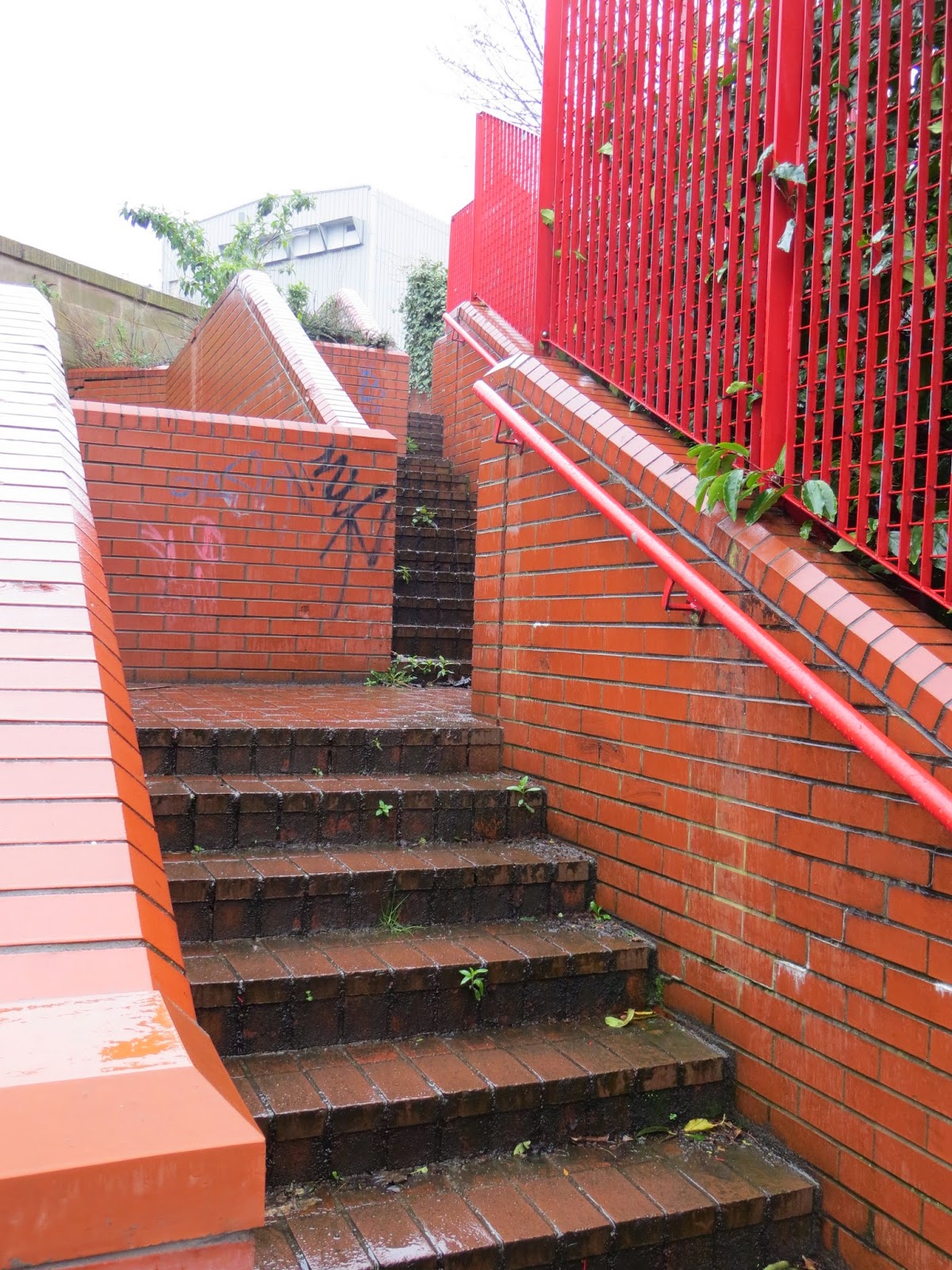
This set of stairs and barrier up to Mosley Rd/Park Rd is the only other access to the southern end of the new section.  Not very welcoming to any cyclist.  A bike won't fit through that barrier.

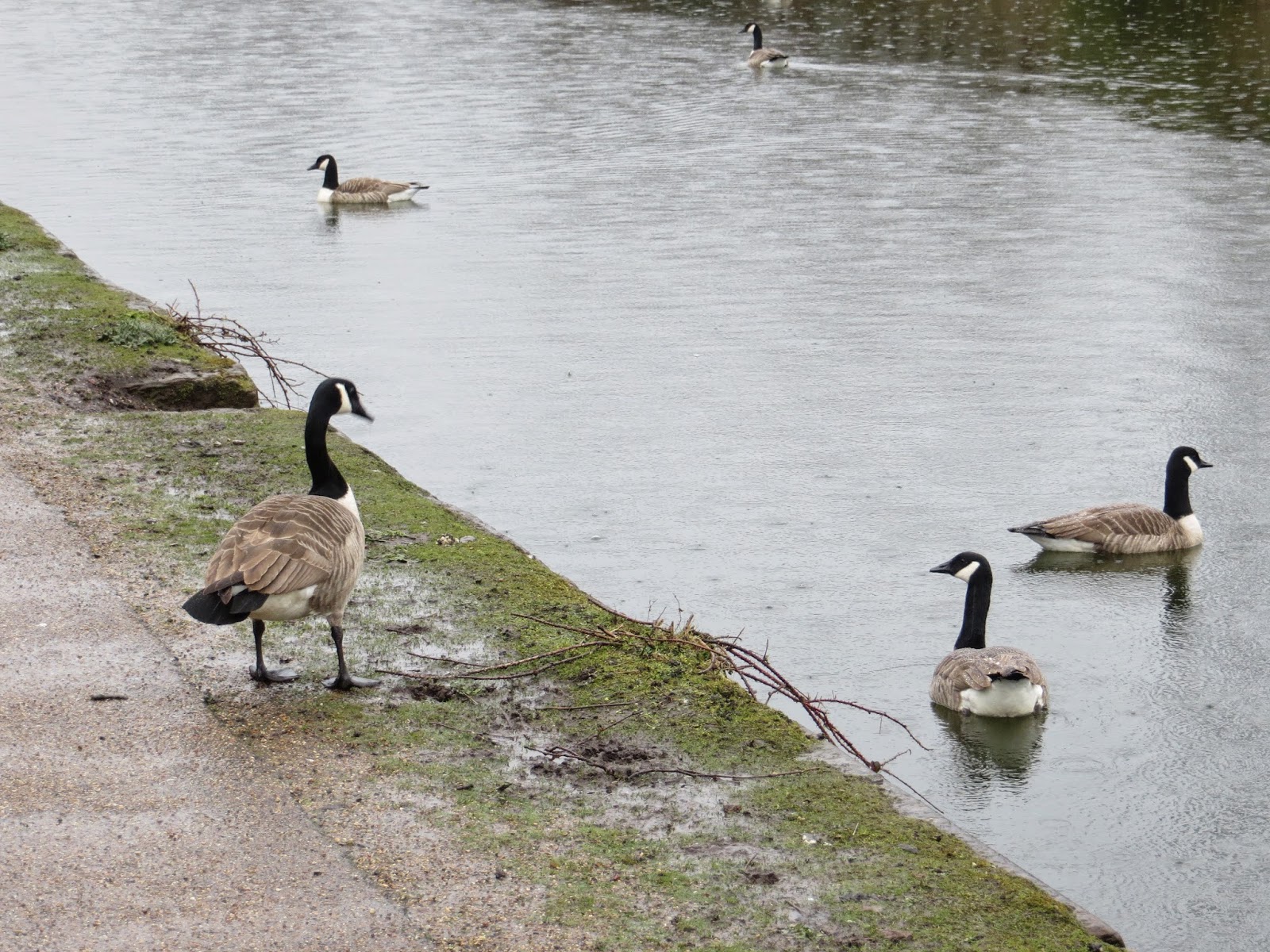
Plenty of the natives (yes I know Canada Geese are not indigenous)

Near the Ship Canal there is this section of cobbles over a bridge.  It needs to be kept for historical reasons but unless you're on large, soft tyres it's painful and wearing on a regular basis.

The Bridgewater Way exits to Redclyffe Road (goes across the bridge) via the existing Chapel Place.  The above is the best view you get of the traffic coming over Barton swing bridge.
 SOMEBODY WILL DIE HERE.
This is the view of traffic coming over the bridge when you get to the junction.  In a word, lethal!  I've raised this with Trafford's cycle officer months ago and he was going to have a site visit, but I've heard nothing since.  At the same time I pointed out that further up the road there was an existing, unused entrance that would provide much better visibility in both directions.  The entrance is just by the pedestrian in the photo below.
Note the useless cycle symbols painted on green squares on the road - these provide no protection whatsoever to a cyclist and do nothing to stop motorists pushing past. 

 Who owns the small bit of wasteland between the canal and the road, I'm not sure but in the two shots  above taken from the towpath a path can be seen though it is not negotiable by bike.  In the last shot it even looks as though at some point there was an official route through.
Crossing the bridge via the footpath is not even an option.  Not only because it is illegal but also because it is so narrow.  There is just enough space for one pedestrian to walk along.

Friday, 11 April 2014

Trafford's Cycle Networks - Part 1 - Trans Pennine Trail

I do a lot of cycling, most of it in order to get to work.  Currently this involves an eleven mile journey each way.  It could be shorter, seven miles, if I was prepared to tackle the main entrance to the Trafford Centre. I'll save that discussion for another day.  Sometimes I take a nine mile road route but having had a hit and run on a relatively quiet road just before Christmas with a subsequent complete lack of interest from GMP, I now prefer the off-road route.

I'm going to look at the provisions Trafford and to a small extent Salford make for cyclists along my route to work. Both have received money in order to provide infrastructure for cyclists, yet like almost all councils across this country are incapable of providing proper first rate facilities.

Survey after survey identifies that the main reason people don't cycle is perceived risk of danger from other road users - the motorist.  For years I've argued that this isn't real, but I've just been kidding myself, it is.  There are a significant number of motorists who's driving falls into the categories of incompetent or showing a dangerous disregard for other people. They're driving round in one tonne plus lumps of metal that can easily extinguish a life in the blink of an eye.

The result is that I have now established a route to work that is largely away from roads.  This route uses cycle facilities that have been developed over the last fifteen years and I'm grateful that they have.  However, as a day to day transport system they leave a lot to be desired. I have had to develop a bike especially for the route and accept that I will get covered in mud and shaken to pieces.  This is just not conducive to encouraging people to take up cycling as a means of transport.

Enough, let the journey begin. Firstly the Trans Pennine Trail (TPT) and getting to it.


Manor Avenue looking north to Carrington Lane from Plymouth Rd.
Manor Avenue is a wide road developed decades ago as the Sale West bypass.  More recently parts of the road have been re-developed to try and reduce the speed of vehicles, you can see the speed camera in the first photo.  There is plenty of space here for proper cycling facilities yet there isn't even a useless splash of paint on the road.  Cycle facilities would provide a more positive and effective means of speed control than the likes of the speed camera - hit the brake, wait a second, blap the accelerator, splat the child.

Having negotiated the queue of cars waiting to queue up on the Carrington Spur I quite quickly come to the first away from road cycle infrastructure - the Trans Pennine Trail (TPT).  The surface here is gritty and hard packed which flicks up onto the bike and coats those expensive chains and gears in a gritty paste.  I wouldn't want to ride a normal bike across here on a regular basis, far too expensive on maintenance.  Add to this a lack of clearance of fallen foliage and several stables in the area and the results are frequent patches of churned up mud like the above.  Stretches of the trail are constantly wet even after several days of no rain.  In the above you can see where cyclists have tried to go around large puddles, but sometimes it is impossible to avoid going through them.  The thin layer of mud adds to the paste grinding away at your bike's mechanicals and can make bike handling sketchy as the tyres slide around.

The TPT through Trafford is plagued with anti-motorbike structures like this.  They didn't work and a lot have thankfully been bypassed. However, the bypass is never official and usually have issues.  In this case it is an off-camber stoney/broken brick surface leading at a shallow angle onto a higher, in places, tarmac surface.  Any experienced cyclist will recognise the danger of a raised edge at a shallow angle - strong probability of tarmac - body interface.

Woohoo, smooth tarmac!  Just mind the constant fresh supplies of not well rotted horse manure, and the thin layer of mud.

The bridge across the River Mersey.  This is a very important non-vehicular link between Ashton-Upon-Mersey/Sale West and Urmston/Stretford.  The alternatives are the A56 at Crossford or the Flixton mile, both quite large detours and neither in the slightest bit appealing from a safety point of view or being pleasant.

If you turn left off the bridge you'll very quickly arrive in Urmston.  However, you have to negotiate this, which, according to the Transport for Greater Manchester cycling maps is a 'Traffic free route - good surface'.  A correction would be 'Traffic free route - totally inappropriate surface'.  The surface doesn't get any better when you head around the corner.  It may or may not be ok for horses, it won't encourage occasional leisure cyclists and is just not acceptable as part of a transport system in a country with the weather system we have.
If you turn right you continue along the TPT but are immediately faced with this at the bottom of a reasonably steep slope.  If you're used to it then it is currently possible to get through ok - keep to the right on the descent and then dive to the left of the puddle.
The route follows the Mersey bank for a short way.  There are puddles, some pretty much permanent like the above, all along this part.  The path is narrow and frequented by horses and dog walkers making reasonable progress on a bike awkward and risky.

The TPT turns away from the Mersey through this safety hazard.  Rough broken brick surface to throw you off balance and sheet metal edges that are just at the right height to slice my fingers off if I get it wrong.  A drop handle bar bike fits through the gap, a flat bar you have to wiggle through with the bars at an angle whilst trying to lift the front wheel up.

The track from this point is wide and whilst in many places twin paths have been worn permitting easy travel in both directions at once there are a lot of places like the above where there is only one semi-decent bit of surface.  Here the mud completely covers over half of the track with a slimey gloop that tyres just will not grip on.  The result is that cyclists and walkers are restricted to one small part of the path heading around virtually blind bends.  Head ons or near hits are virtually inevitable unless everybody goes at walking pace - what's the point of it being a cycle path then?

As part of widening the M60 to ten lanes wide the TPT was diverted from its original route through a pitch black rough surfaced tunnel - whoever thought that was a suitable safe route should be fired and never allowed to design transport systems again.  The new route crosses Kickerty Brook by this concrete bridge.  There's not much wrong with the bridge itself except that you are turning through 180 degrees and there are muddy puddles on both approaches.  This results in a slippery surface exactly where you could do without one.


Get it wrong and this is where you are going.  It won't be pleasant and it will hurt - a lot.

The bridge over the M60 shows what can be done when proper levels of money are invested.  Nice tarmac surface, decent width.  Not sure what the spiral decent on the Stretford side would be like in the ice though!


I'd hate to think just how much money was thrown at this widening scheme in the interests of keeping the traffic moving.  These views are fairly typical of morning rush hour.  I suppose I should grow up, get a proper job and earn some real money then I could join them.


The route from the bridge is a rough stoney surface accompanied by the compulsory path wide puddles.  The above shots show the typical surface which make anything other than big fat, soft, off road tyres extremely uncomfortable and damaging to the bike.
The path passes under the A56 via this gloomy bridge.  Most of the time it is impossible to see what you are about to ride over even during the day.


Away from the A56 a lack of maintenance has resulted in a path that was once six foot wide now being a thin muddy strip.  The first photo shows the muddy state of the path on a tight bend with no visibility lines.  The second shows a series of three constant puddles.  These three are particularly gloopy and you can see the state of the bank to the left where people have tried to avoid them.  The problem along this stretch seems to be the playing fields to the left draining across the path to the brook on the right.


At this point I leave the TPT and join the Bridgewater Way via this link.  Across the brook the surface is badly broken up and then gives way to yet more of that stoney surface as you try and climb the steep slope to the canal.  Coming back is hair raising and down right dangerous if people try and come up at the same time as you go down.